
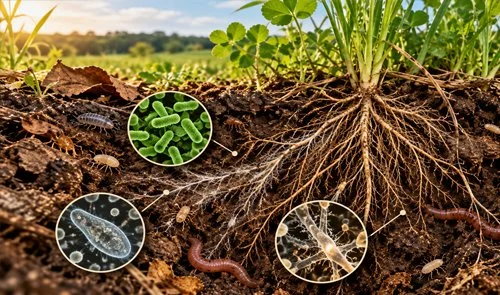
When we look across a pasture, garden, or crop field, most of our attention naturally goes to what we can see above the ground. But beneath our feet is an active community of organisms that plays an important role in how soil functions. Bacteria, fungi, protozoa, earthworms, and countless other organisms live and interact in the soil. Together, these organisms and their relationships with plants make up what is commonly called the soil food web.
Understanding this underground workforce can help us look at soil differently. Soil is not simply dirt that anchors plants and stores water and nutrients. It is a living ecosystem where plants and soil organisms interact, organic materials are broken down, and nutrients are continually used and recycled.
Plants and the life around their roots
Plants are an important starting point because they do more than take water and nutrients from the ground. Through photosynthesis, plants capture energy from sunlight and convert it into carbon compounds. Some of these compounds travel down through the plant and are released from the roots as root exudates, which can provide food for microorganisms living nearby.
This creates an important relationship. Plants provide carbon that supports microbial life, while many microorganisms participate in processes that help cycle nutrients through the soil. The area immediately surrounding a root, known as the rhizosphere, can be one of the most biologically active areas in the soil. What appears above ground to be a single plant is actually connected to a much larger community below.
The microscopic workers
Bacteria are among the smallest members of this community, but they have a large role. They help break down plant residues, roots, manure, and other organic materials while participating in nutrient cycling. Although we cannot see this activity while walking through a field, enormous populations of bacteria may be living around plant roots and throughout the soil.
Fungi are another important part of this underground workforce. Their threadlike structures, called hyphae, extend through tiny spaces in the soil. Some fungi break down tougher organic materials, while others form beneficial relationships with plants. Mycorrhizal fungi, for example, associate with the roots of many plants. The plant provides carbon to the fungi, while the fungi can help the plant explore a larger volume of soil for water and certain nutrients.
Protozoa are also part of this system. Many feed on bacteria, and through this process nutrients contained within those bacteria can be released back into the soil environment. It is a good example of why the soil food web is called a “web.” Each group is connected to others, and nutrients continually move through the system.
The workers we can see
Earthworms give us an opportunity to see part of the soil food web without a microscope. As they move through the ground and consume organic materials, they help mix residues and soil while creating channels. Those channels can provide pathways for water, air, and plant roots.
Finding earthworms can be an encouraging sign of biological activity, but they are only one clue. Their numbers naturally change with soil type, moisture, temperature, season, food availability, and management. Not finding worms in one shovel of soil does not automatically mean the soil is unhealthy.
How our management affects the workforce
What happens above ground can influence what happens below it. Living roots provide a food source for soil organisms. Ground cover can help moderate soil temperature and conserve moisture. Plant diversity provides different types of roots and organic materials, while excessive disturbance can disrupt soil habitat and fungal networks.
This does not mean there is one management prescription for every farm. A pasture, vegetable garden, and row-crop operation have different soils, equipment, crops, weather, and economic considerations. The important point is understanding that management decisions affect more than the plants we see—they can also affect the biological community beneath them.
Think below the surface
The next time you walk across a pasture, crop field, or garden, consider everything happening underneath your boots. Organisms are decomposing organic matter, cycling nutrients, creating channels, forming networks, and interacting with plant roots. Most of this work happens without us ever seeing it.
That is one reason regenerative agriculture places so much emphasis on treating soil as a living system. Last week, we looked at field clues that can help us begin reading the soil without a laboratory. Understanding the soil food web adds another piece to that investigation.
As we continue toward USARAAI's Soil Health CSI workshop on November 7, we will keep investigating what the soil can tell us. Next week, we will look at another important clue: soil compaction—how to recognize it and what it can mean for plant roots, water, air, and the life within our soil.
Source Notes
USDA Natural Resources Conservation Service (NRCS), educational resources on soil biology, soil health, and the soil food web.
USDA Agricultural Research Service (ARS), research and educational information on soil microorganisms and plant-microbe interactions.
University and Cooperative Extension educational resources on mycorrhizal fungi, earthworms, soil biology, and nutrient cycling.
