
Your Soil Is Talking: 7 Field Clues You Can See Without a Lab
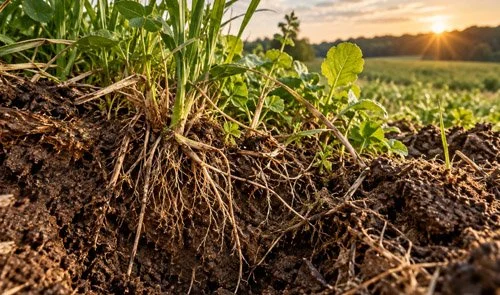
You do not need a laboratory report to begin learning about your soil. A soil test can provide valuable information, but some of the first clues about soil health are already visible in the field. The way water moves, the shape of plant roots, the amount of bare ground, and even the smell and feel of the soil can tell us something about what is happening below our feet.
Regenerative agriculture begins with observation. Before deciding what the soil needs, it helps to slow down, look closely, and ask: What is the soil trying to tell me?
1. Look at how water behaves
After a hard rain, does water disappear into the ground or sit on the surface? Do you see muddy runoff leaving a field, garden, or pasture? Water that infiltrates the soil becomes available to plants. Water that runs away can carry soil and nutrients with it. Ponding and runoff can also be clues that the soil surface is sealed, compacted, or lacking enough structure and cover.
2. Look for bare ground
Bare soil is exposed to direct sun, wind, and the impact of raindrops. Walk across the area and estimate how much of the surface is protected by growing plants, plant residue, mulch, or other organic material. Ground cover is not just something that makes a field look better; it helps protect the soil surface and creates a more favorable environment for biological activity.
3. Dig up a plant and study its roots
Healthy-looking leaves do not always tell the entire story. Carefully dig around a plant so you can examine the root system. Are the roots spreading in several directions and moving deeper into the soil, or do they turn sideways at a certain depth? Are they thick, stubby, or restricted? Root shape can reveal physical barriers that are difficult to see from the surface.
4. Feel the soil
Pick up a handful when the soil is moist but not saturated. Does it break into small crumbs or into hard, dense chunks? Good soil structure often produces aggregates—small groups of soil particles held together in a way that leaves spaces for air and water. The goal is not a particular texture everywhere; sandy, silty, and clay soils naturally feel different. The useful question is whether the soil behaves well for the soil type you have.
5. Use your nose
Healthy soil often has a rich, earthy smell. Sour, stagnant, or unusual odors may be a reason to investigate drainage, compaction, or other conditions. Smell is not a laboratory measurement, but it is one more observation that can be recorded alongside what you see and feel.
6. Look for life
Earthworms, beetles, insects, fungal threads, decaying roots, and other signs of biological activity remind us that soil is an ecosystem, not simply a material that holds plants upright. You will not see every important soil organism with the naked eye, but visible life and active decomposition can provide useful clues.
7. Compare one place with another
One of the best ways to learn is to compare. Dig in a heavily traveled area and then in a protected area. Compare a covered patch with nearby bare soil. Compare a pasture that has had adequate recovery time with an area that has been repeatedly grazed short. Differences in roots, moisture, aggregation, temperature, and biological activity can make soil-health concepts much easier to understand.
Start with observation
No single field clue tells the whole story, and observations do not replace appropriate soil testing. They do, however, give us a place to begin. Take photographs, make notes, repeat simple observations through the seasons, and watch for change over time. The purpose is not to label soil as simply “good” or “bad.” It is to understand how the soil is functioning and identify questions worth investigating.
That is also the idea behind USARAAI’s Soil Health CSI workshop on November 7: look beneath the surface, examine the evidence, and learn what the soil may be telling us. Over the next several weeks, this blog will take a closer look at soil biology, compaction, water infiltration, and plant roots so readers can build a practical soil-health toolkit of their own.
Source Notes
USA Regenerative Agricultural Alliance, “The Five Principles of Soil Health,” existing blog archive.
USA Regenerative Agricultural Alliance, “Cover Crops Provide Advantages for Soil and Livestock,” existing blog archive.
USA Regenerative Agricultural Alliance, “Healthy Soils: The Foundation of Regenerative Agriculture,” existing blog archive.
USA Regenerative Agricultural Alliance, “Starting a No-Till Garden,” existing blog archive.
USA Regenerative Agricultural Alliance, current Soil Health CSI event page and organization website, accessed September 21, 2026.
